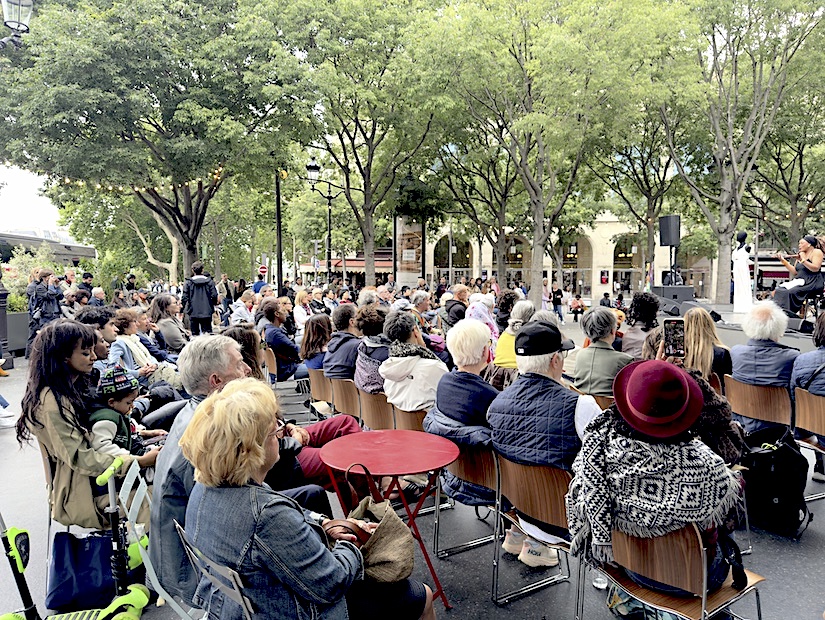
A Performance to Remember
Georgia Sanders, Founder and Editor of CultureHoney.com and I met poet, author, artist and educator Shonda Buchanan in Paris at the open-air Théâtre de la Ville project, supported by Paris Mayor Anne Hidalgo. It was a cloudy Sunday in the leafy Place Châtelet, where an enactment of the life of Nina Simone preceded Shonda’s poetry reading from her latest book, and launch tour The Lost Songs of Nina Simone.
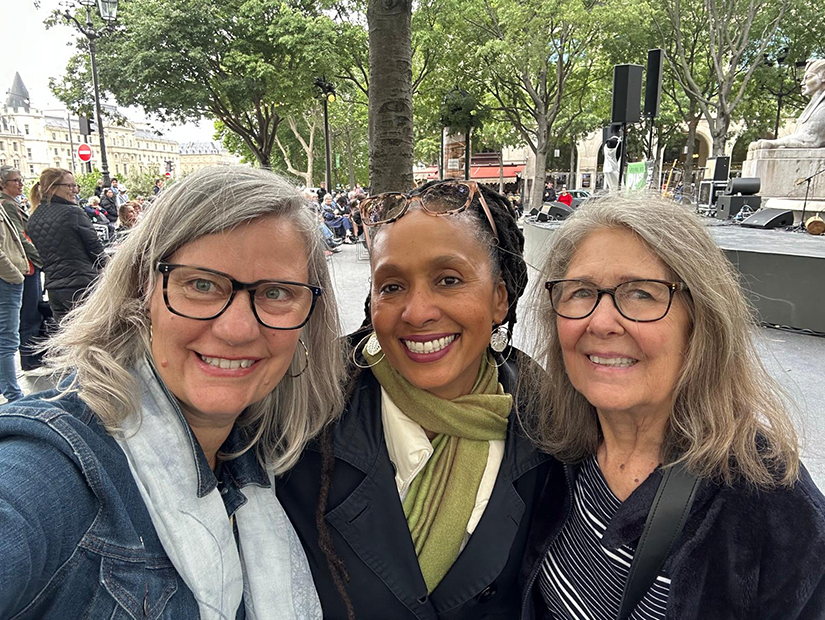
Georgia Sanders and myself meeting Shonda Buchanan at Théâtre de la Ville, 2 Place Châtelet, 75004 Paris.
The performance is a poetic, jazz-infused interview-style documentary in which Cie du Kaïros / David Lescot Frames Ludmilla Dabo who embodies Nina Simone. The on-stage mannequin dressed in white evokes a sense of pure, divine creative power—an abstract representation of the human condition. In contrast, Dabo’s black ensemble symbolizes fiery intensity, capturing the commanding presence of Simone as both artist and human.
Through a powerful performance, Dabo channels Simone’s soul – the inner agony shaped by abuse, adversity, disappointment, and the experiences that ultimately fueled personal growth and activism, In tandem, she honours her own soul. The piece underscores how individual stories, like Simone’s, become interwoven with collective memory and resonate through our own personal histories. Art is Living, Living is Art,
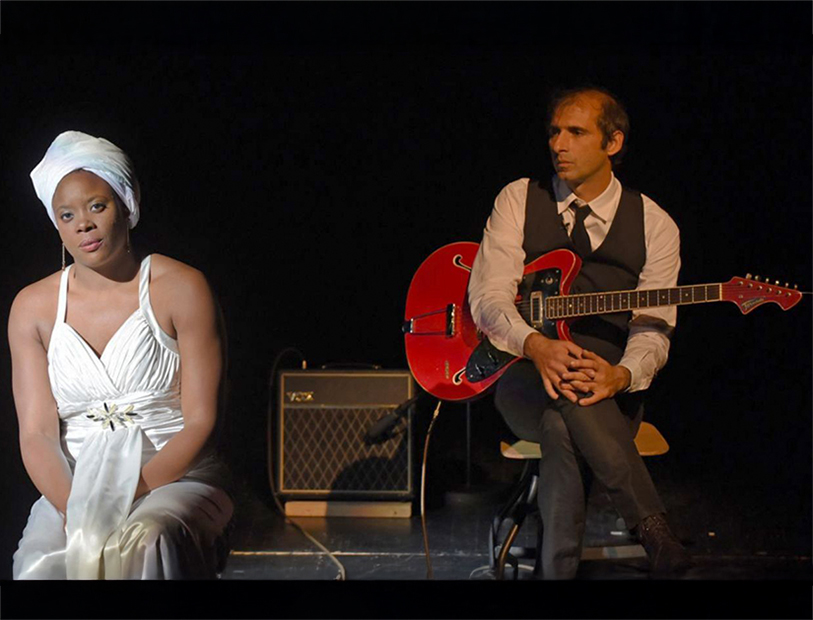
Screen capture_Photo credit: headerportrait portrait _Ludmilla, Cie du Kaïros / David Lescot, Ludmilla Dabo Théâtre de la Ville,2 Place Châtelet, 75004 Paris.
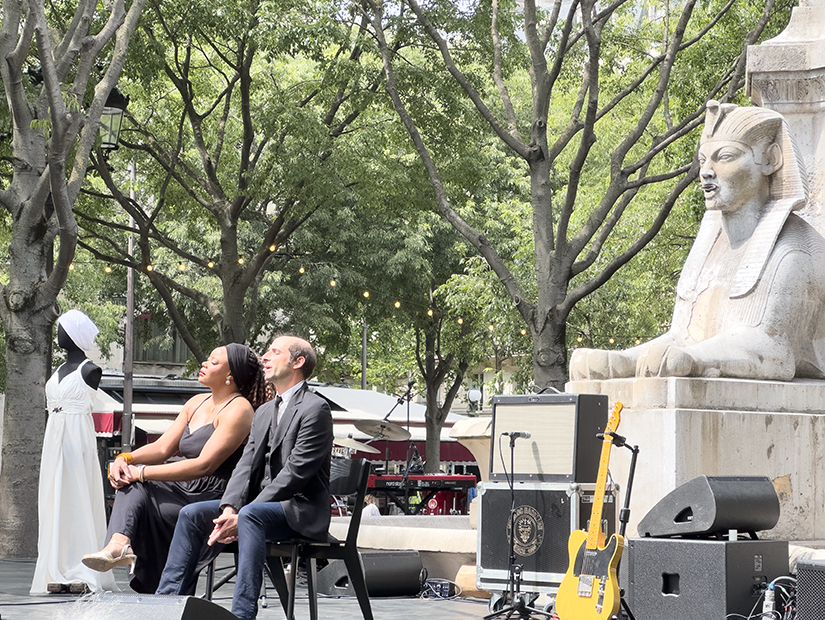
Interpretation/Documentary-a musical ‘jazz-style’ interview commences; Cie du Kaïros / David Lescot, Ludmilla Dabo Théâtre de la Ville, 2 Place Châtelet, 75004 Paris.
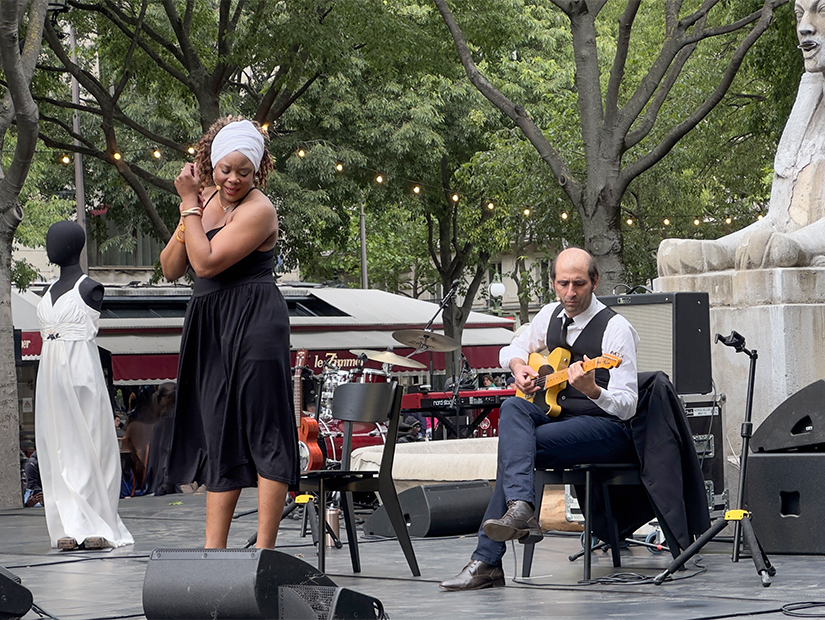
Théâtre de la Ville, 2 Place Châtelet,75004 Paris, Interpretation jazz documentary style Interview Interpretation exposes the intense artistic life of pain pleasure, loss and success of Nina Simone.
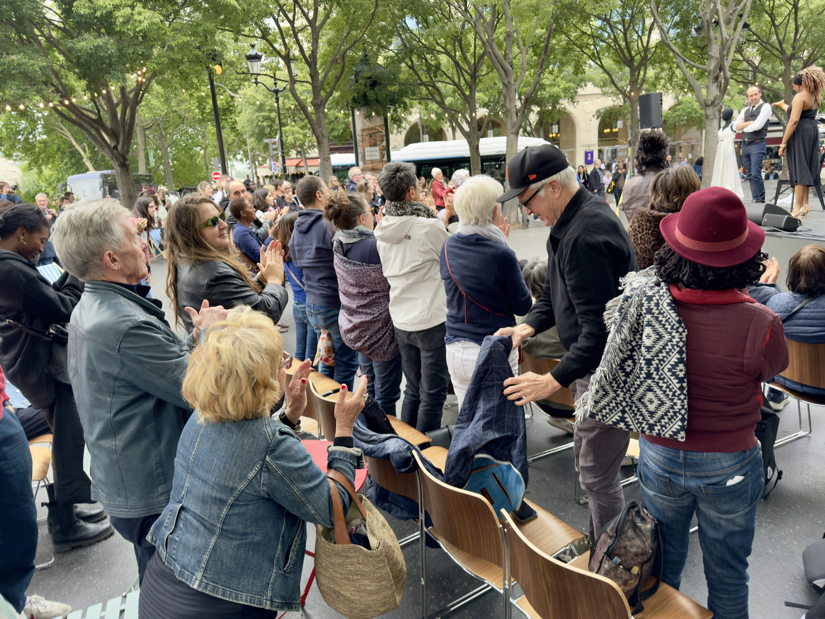
Audiance bounds to an energetic and enthusiastic standing ovation in appreciation of the performance memorialising Nina Simone. Theater company Cie du Kaïros / David Lescot, Ludmilla Dabo Théâtre de la Ville,2 Place Châtelet,75004 Paris
Afterward, springtime sprinkles encouraged the audience inside for Shonda’s poetry readings. Shonda, is an award-winning writer with degrees from Antioch University and Loyola Marymount. Please see ‘About Shonda Buchanan” to fully grasp her abundant legacy of accomplishments, activities and awards. Perhaps you will link with a common interest.
Shonda has spent over 25 years researching Nina Simone, and The Lost Songs of Nina Simone, which is both a chronological/literary and emotional ‘exposé’ of Simone’s legacy as a Black woman living under Jim Crow laws. What prompted her devotion to know and to share Nina Simone?
Childhood, the Beginning
Shonda listened to Nina Simone as a child, and later as similarities in heritage revealed themselves, and passion for her music grew, she was curious and impassioned to discover Nina’s full range of experiences. Her inspiring performance, commanding and equally delicate, included songs that summoned the veritable presence of American Indians.
Shonda, born and raised in Kalamazoo Michigan was surrounded by the Great Lakes, streams rivulets, swampland and tribal territories. Her book Black Indian, a reflection of de-evolution of the status of a free people of color, is infused with landscape of her heritage, family dysfunction, and oral history of her Indian, Black American, European heritage. Her family life was high volume and rich in laughter. Her ‘coming of age’ was ushered in with her reading of I am the darker Brother, 1968; “Wow , Black people are talking about what it means to be Black.” Shonda notes ” We need to know where we came from. You must know who you are, or you won’t know where you are going.” Free Black Americans could own land, have slaves, vote in the 1700s 1800s. To reclaim pre-existing power talking about nationhood, nation- building, unity and community we need to know where we’ve been. “Sure, forty acres and a mule helps ! And it is not enough. It’s not even enough.”
Shonda is to the word as Nina is to music, she grew up practicing poetry to “heal with language” using it as a tool for transformation and redemption for the disparity in equality. Curiosity of course, as the writer’s best friend, lead her to explore her “Americanness.” I know I have certain rights that being American grants – certain perceived rights to march, fight, protest in action and intellect. I am not experiencing inalienable rights as is evidenced by those brothers and sisters with the same ‘American rights’ being detained at the border even though they hold the same American status. “So, why do we always have to fight for our Americaness?”
Shonda acknowledges, honors and holds dear, the names hearts and efforts of her ancestors for the parts they played in her creation. Thus she follows her heartfelt devotion to her constant apprenticeship, and evolution of her craft begun in her early 20s. She is determined to make sense of her life as a tri-ethnic American.
She holds gratitude close as she continues reading and practicing poetry exploring race, ethnicity, identity, gender, and spirituality. Her book is palpable motion forward as she finds unity in Nina’s courage, and sisterhood in the multi-ethinc place in America. Her artistic revelation, as described, “embodies the rich legacy — the pleats between the cloth — of Simone’s artistry, beauty, self-immolation and rage.”
As is the current state of humanity, the collective yet swirls and rumbles the underpinnings of Simone’s life’s work; yet also resonates with current growing awareness, of the importance and power of our collective consciousness, and the importance of equality in humanness.
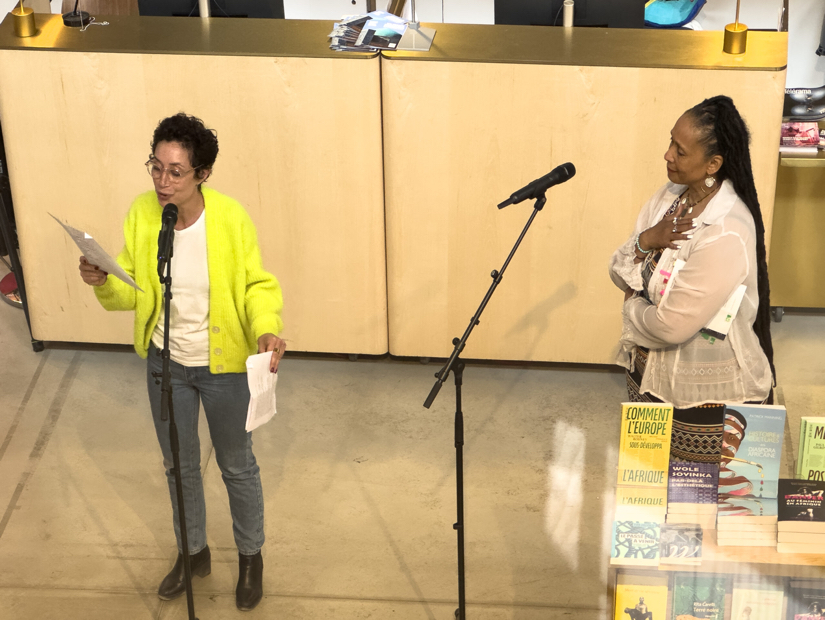
Shonda Buchanan poetry reading “Lost Songs of Nina Simone” French translation impressively delivered by Johanna White Palacio and visibly appreciated by the author Théâtre de la Ville,2 Place Châtelet,75004 Paris
Collective Consciousness and Artistic Power
Collective consciousness refers to the shared beliefs, values, and knowledge that shape societies. From ancient indigenous cultures to modern psychology and neuroscience, this concept has been explored in how identity, behaviour, and cohesion evolve. Art, especially, speaks directly to the heart—cutting through intellectual defenses and inspiring empathy and unity.
Authenticity and courage in the arts assert truth, claim leadership and inspire change. These values are embodied by Simone in her lifetime, and are currently embraced and demonstrated by Shonda, and Paris Mayor Anne Hidalgo.
And, Nina Simone?
My favorite ‘Nina citation’ exclaims:
“I’ll tell you what freedom means to me. No fear.” Nina Simone ~ (1933-2003).
Nina’s growth resounded throughout music via “the rights to march, to protest and to fight granted by Americanness.”
Her fierce belief in justice appeared early, and while I deeply recognize it, I never really was the brave ‘warrior princess’ as I had imagined myself to be. At age 12 in her first classical recital, Nina refused to perform until her parents were allowed to sit in the front row—after being moved to the back to make room for white guests.
Born Eunice Kathleen Waymon in 1933 in Tryon, North Carolina, Her strict Methodist preacher mother introduced Simone early to gospel and classical music. Simone, was a musical prodigy who began playing piano “before her feet could reach the pedals.” When she discovered Bach, she was spellbound— she “almost vanished as it was so beautiful” and thus it became her vision and dream of becoming the first Black classical concert pianist. Yet, she adopted the stage name “Nina Simone”—”Nina” from a boyfriend and “Simone” after French actress Simone Signoret—to hide her secular performances from her religious mother. She evolved her talents to blend gospel, jazz, blues, folk, and classical music, creating her signature style. Her father also was an entertainer, barber and dry-cleaner known as a whistler. A happy home, yet there is more.
Shonda discovered that Nina was from North Carolina and her family were mixed race. As this chimed an epiphany to her own journey and ancestry, she was inspired and curious to unravel the strains of her ethnicity. As Shonda’s particular expertise in history, heritage and identity, she wanted to tell the story of this woman who significantly impacted the world.
Shonda’s collection is structured into six sections. Each one correlates to a theme and stretches into emotions of belonging, fear, pride, loss, and survival of self. The anchor to ancestry profoundly enriches the aesthetic of the collection that reaches out through voices, times and spaces. For example she captures the sound; Nina’s – never quiet house – was always filled with music, either singing, piano or another invited instrument.
Shonda’s artistry was based on her own research. For example, as she knew Nina was her muse, she intended to protect the communication to be ‘purely’ Nina. For the authenticity of her own artistry, she did not interview Nina’s daughter, or see films within the bounds of her research. In her dreams, Nina came to assess whether or not she was ‘good enough’ to write about her. Shonda devoted herself to maintain Ninas’s voice as a performer, a daughter, a mother, an activist and a world traveler.
The two pieces Watchnight I and Watchnight II were born to capture Ninas’s roles as a child playing in the steamy summer southern nights to support the essential need of Black folks who relied on church and religion to endure their lives in a racists state. And like many aspects in Nina’s life, her belief in religion “flayed and faltered.”
The closer Shonda came to Nina, the clearer the mirror of her own life was polished. As a Black woman she had experienced the rollercoaster of balancing a life as an artist, mother, daughter, and partner, and thus more clearly could see feel understand the permanence of the struggle and the depths of the buried hopes.
Nina as Artist and Activist
Simone’s dream was shattered when the Curtis Institute of Music denied her admission—an experience she believed was due solely to her race. She had already received support from patrons to attend a private school and later Juilliard, but the Curtis snub remained a scar. Though the Curtis Institute did admit Black men, her rejection ignited an enduring rage that fueled her activism and artistry.
Simone recorded over 50 albums, many with Bethlehem Records, and rose to prominence during the Civil Rights era. Songs like Mississippi Goddam and To Be Young, Gifted and Black became anthems of the movement.
In the 1990s, Simone moved to France, where she lived until her death in 2003. She performed in Paris and at London’s famous Ronnie Scott’s jazz club. Simone’s life was marked by intense emotional struggles, later diagnosed as bipolar disorder, and a history of both personal trauma and institutional racism. She never returned to the U.S., famously calling it the “United Snakes of America.”
Her legacy lives on through her daughter Lisa Simone Kelly, an actress and singer who starred in Aida on Broadway and performs under the name Simone. Shonda believes Simon’s story and works should be taught in schools. As instruction and inspiration, her music, words, and her devotion to activism for justice could inform younger generations to learn to be true to, and to care for, themselves as artists and citizens of a collective. We do need leaders wit a consciousness of collective advancement.
Perhaps we should focus a non-religious spiritual unity. Sovereignty in:
Eudaemonia — human flourishing, thriving, – innate potential of each individual to live a life of enduring happiness, penetrating wisdom, optimal well-being and authentic love and compassion. Build community and …#People: Let People Be
Anne Hidalgo: Bicultural Socialist Visionary
Paris is exigent and not easily satisfied. Anne Hidalgo, Mayor of Paris, is in my experience, an example of an authentic and courageous leader. Born in Spain during the oppressive Franco regime, her family emigrated to France when she was a child. She became a French citizen in 1973 and grew up in Lyon’s working-class neighborhoods. I find her work as a politician incredibly inspiring, and a testament to women’s political leadership.
With advanced degrees in social labor sciences and law, Anne began her career in labor inspection, breaking gender barriers. By 1994, she joined the Socialist Party, advising Prime Minister Lionel Jospin on employment equality for women.
A Mayor with a Mission
Paris’s first female mayor, and she is well-known for her environmental activism. She’s spearheaded bold reforms to fight climate change, which also enhance individuals’ personal experiences in the city. She has banned daytime diesel car use, aiding reductions in emissions in accordance with stated milestones of the Paris Climate Accord. She has reserved the Champs d’Elysées for pedestrians on the first Sunday of each month which enhances community access and appreciation, for access to the ‘overly-occupied iconic shopping avenue.’ She has expanded hundreds of miles of bike lanes, and reclaimed car-heavy zones like the Georges Pompidou expressway for pedestrians and cyclists. As we celebrate 10 years after the Paris Climate Accords, “Chapeau “Anne and team. And today people are swimming in the Seine!
Under Hidalgo, the vision is Paris transformed into a “15-minute city”, aiming to make all essentials accessible within a short walk or bike ride. While all to often citizens see little or nothing of the changes promised or legislated targets for improvement completed. Yet Paris now ranks among the top bike-friendly cities globally, up from 17th in 2015 to 8th in 2020. “We’re trying to build this around the individual. But change is difficult.” “We can’t live as before,’’ Ms. Hidalgo added “There’s been an acceleration in climate change.”
Critics, especially drivers, oppose some changes, but Hidalgo remains committed. For the most part, she has delivered on her promises. Even amongst her critics, nobody doubts her commitment to these reforms.
Her support for public art, including projects like Le Théâtre de la Ville-Sarah Bernhardt, reflects her belief in civic space as a stage for global cultural exchange. Another noteworthy citation, she says: “You have to work on your relationship with power … criticize, analyze, then act.”…once you have decided on a path, follow it. Otherwise, you are just a headless chicken,” reports The Guardian.
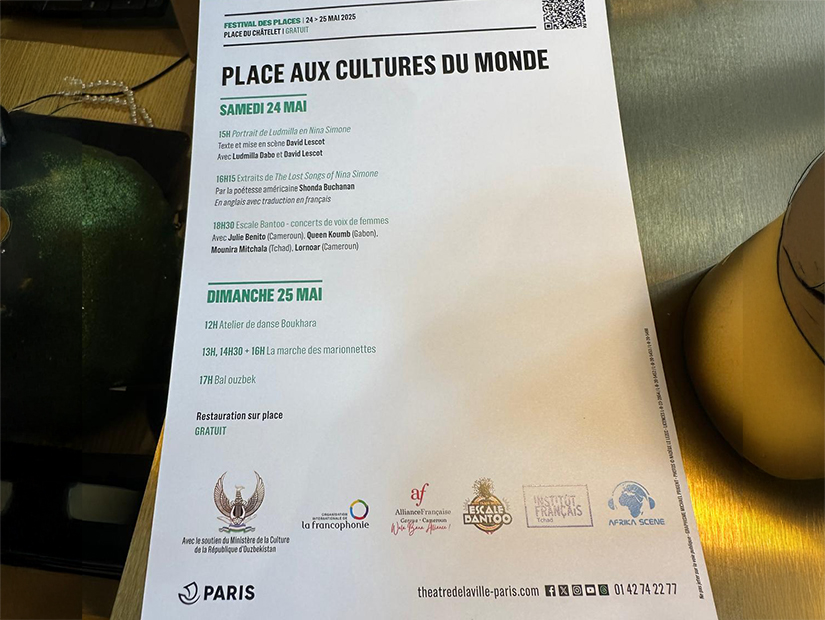
Official Announcement, Documentary-Interpretation musical ‘jazz-style’ Interview Théâtre de la Ville, 2 Place Châtelet, 75004 Paris,
Women Who Lead with Heart and Vision
As I listened carefully to Shonda’s accompanying French translation, delivered by actress Johanna White Palacio, I noticed how this rendition graced my heart-felt perception with yet another enriching layer. This is art working its magic. A validating moment to expand my perception of my own good fortune to live in Paris, to grow in French culture and to experience this moments to appreciate women: strong leaders who artfully act in their authenticity:
Shonda, Nina, and Anne each embody leadership rooted in awareness, authenticity, and action. And notably, each comes from mixed cultural and ethnic backgrounds. It is generally noted that cultural/national and ethnic intersections enrich perspectives that inform experiences and empower action.
The engagement and work of these women highlight the importance of women’s leadership, gender equality, and the transformative power of art and activism. As educators, artists, and politicians, they encourage communities to rise, learn, and lead. Their lives inspire support for mentorship, education, and genuine commitment to humanity. Future generations can look to examples of awareness, authenticity and action that uplift and encourage female leaders. Glance into your own neighbourhoods, as women, in many arenas, demonstrate unmistakable *Resilience in leadership; *Empathy and courage; *Visionary thinking,*Transformative social action.
Poetry, especially in the hands of skilled and devoted artists like Shonda Buchanan, has a unique role in this leadership narrative. It bypasses the intellect and speaks directly to the heart, circumventing logic and defense mechanisms. Unlike other art forms that may appeal to reason or visual sense, poetry penetrates emotional and spiritual realms. It connects us to universal truths—grief, joy, injustice, love—through metaphor, rhythm, and voice.
In a world increasingly shaped by analytics and polarisation, poetry reminds us of our shared humanity. As Simone said, “No fear.” And that’s what poetry can nurture: courage to feel, to question, and to act.
Invitation: Join the Movement
The lives and work of Shonda Buchanan, Nina Simone, and Anne Hidalgo invite us to reflect, celebrate, and participate in shaping a more just and aware society. Their stories aren’t just historical; they are calls to action—to lead, to speak, to create, and to amplify the voices of women everywhere.
Follow Shonda Buchanan: shondabuchanan.com
Subscribe to her newsletter or follow her on social media to stay connected with her work and message. And, pick up her new book, it is a moving experience.