Surges of disbelief and joy had been happening to me a lot since coming to the Dordogne in France.
The medieval, honey-colored villages; the impossibly grand, rivaling cliffside châteaux; and the sweeping countryside carved with rivers, all softly lit and sparkled by the sun. Nevertheless I was unprepared for my visit to Lascaux IV, which was a profoundly moving experience.
Visiting Lascaux, France’s Sistine Chapel of the Prehistoric World, Photo Credit: Victoria Patterson
The Cave of Secrets
Located near the village of Montignac in the Vézère Valley, Lascaux is a network of caves that contain over 600 prehistoric paintings and 1,500 engravings created by Paleolithic humans. Dating back over 17,000 years, it’s been called “the Sistine Chapel of the prehistoric world,” because of the beauty in the depictions of animals such as horses, bulls, and stags, alongside unexplained symbols, which decorate the walls and the tops of the caves.
After the caves were discovered in the 1940s (more on that later), visitors flocked to behold them. The increased carbon dioxide and moisture from their breath caused mold and algae to grow. For preservation’s sake, Lascaux was closed in 1963.
Lascaux IV, an exact replica of the original cave where visitors were allowed, located in the same region, opened in 2016.
Visiting Lascaux, France’s Sistine Chapel of the Prehistoric World, Photo Credit: Victoria Patterson
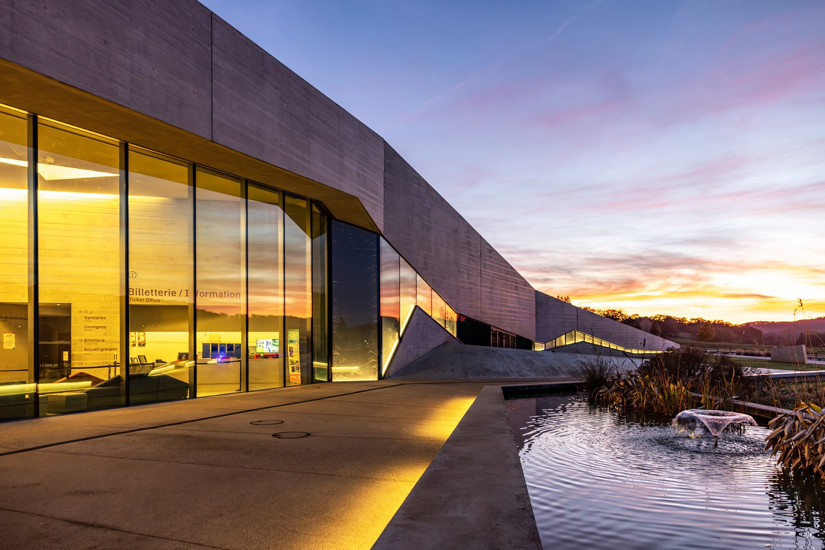
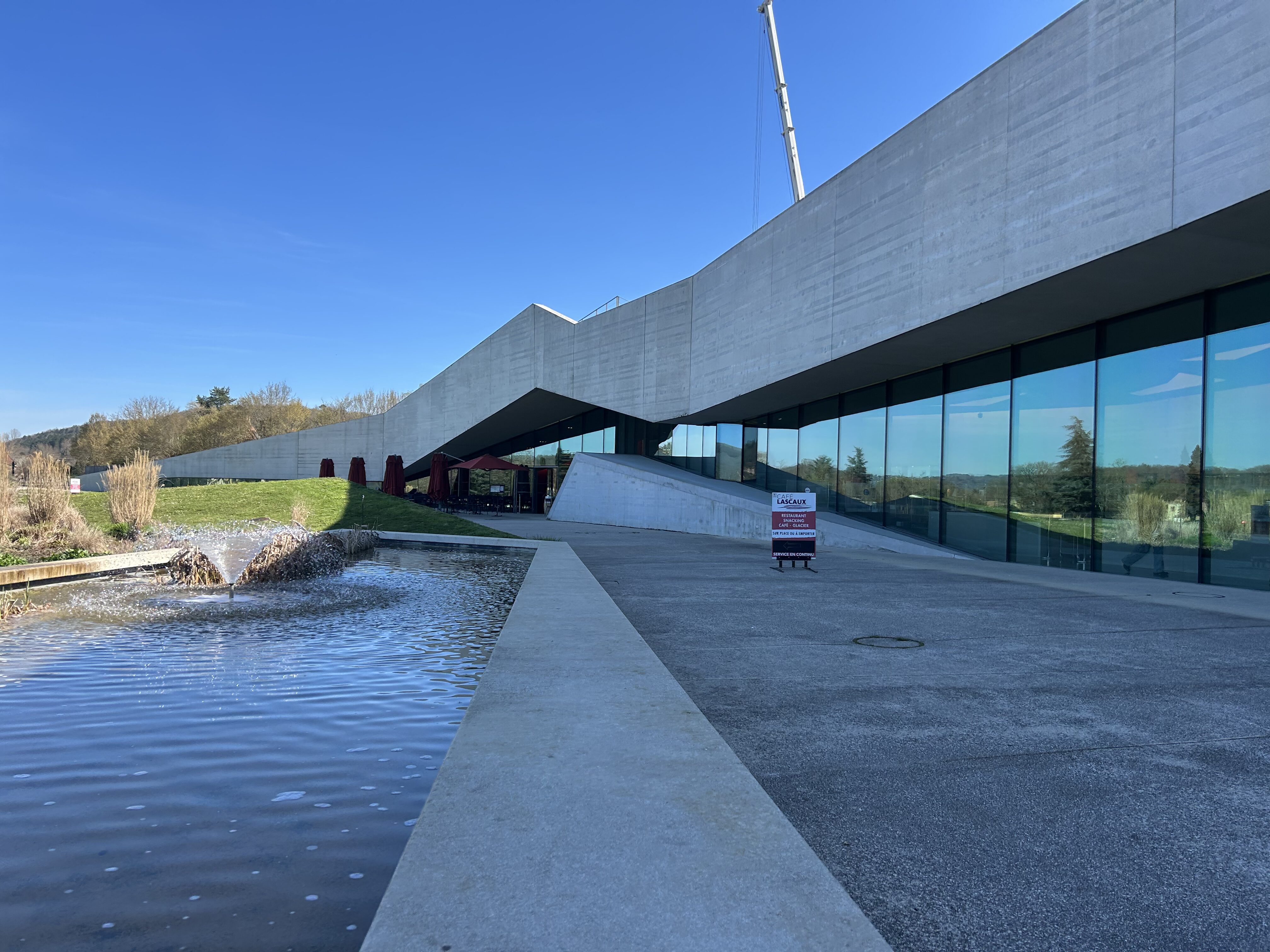
Lascaux IV is situated in a striking concrete building shaped somewhat like an elongated triangle.
The ticket included a one hour guided tour, followed by a self-guided exploration accompanied by an audio handset, so I spent well over two hours there. When I had finished both the guided tour and my own exploration, I sat outside at the café to collect myself. Kids–most likely on field trips–played and chased each other on the sunlit grassy grounds, their pattering feet and excited chatter surrounding me.
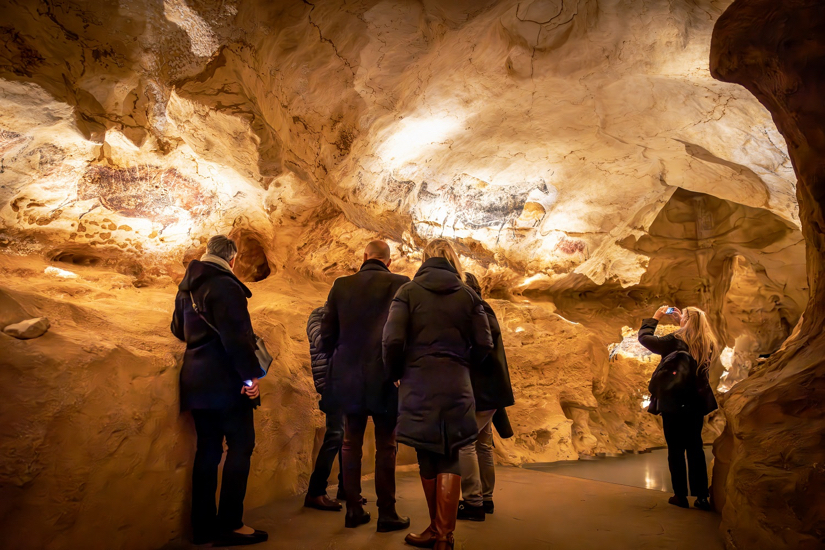
Groupe – Lascaux – © Déclic&Décolle
My visit had begun in the lobby of Lascaux IV, where I’d gathered with the others in my group. The guide for the English-speaking tour, Gwenn, had joked about his grasp on English. When he’d asked if there were any Americans, of the fifteen or so of us, mine was the only hand that raised. Before we entered the caves, we watched a short film that took us through time, beginning at the Ice Age, so that we envisioned the changing landscape and animal life. Then we took an elevator to the belvedere out on the roof, with a view of the terrain, where the original Lascaux exists somewhere behind a glass barrier.
An audible reenactment of a foursome of teenaged young men played over our headsets.
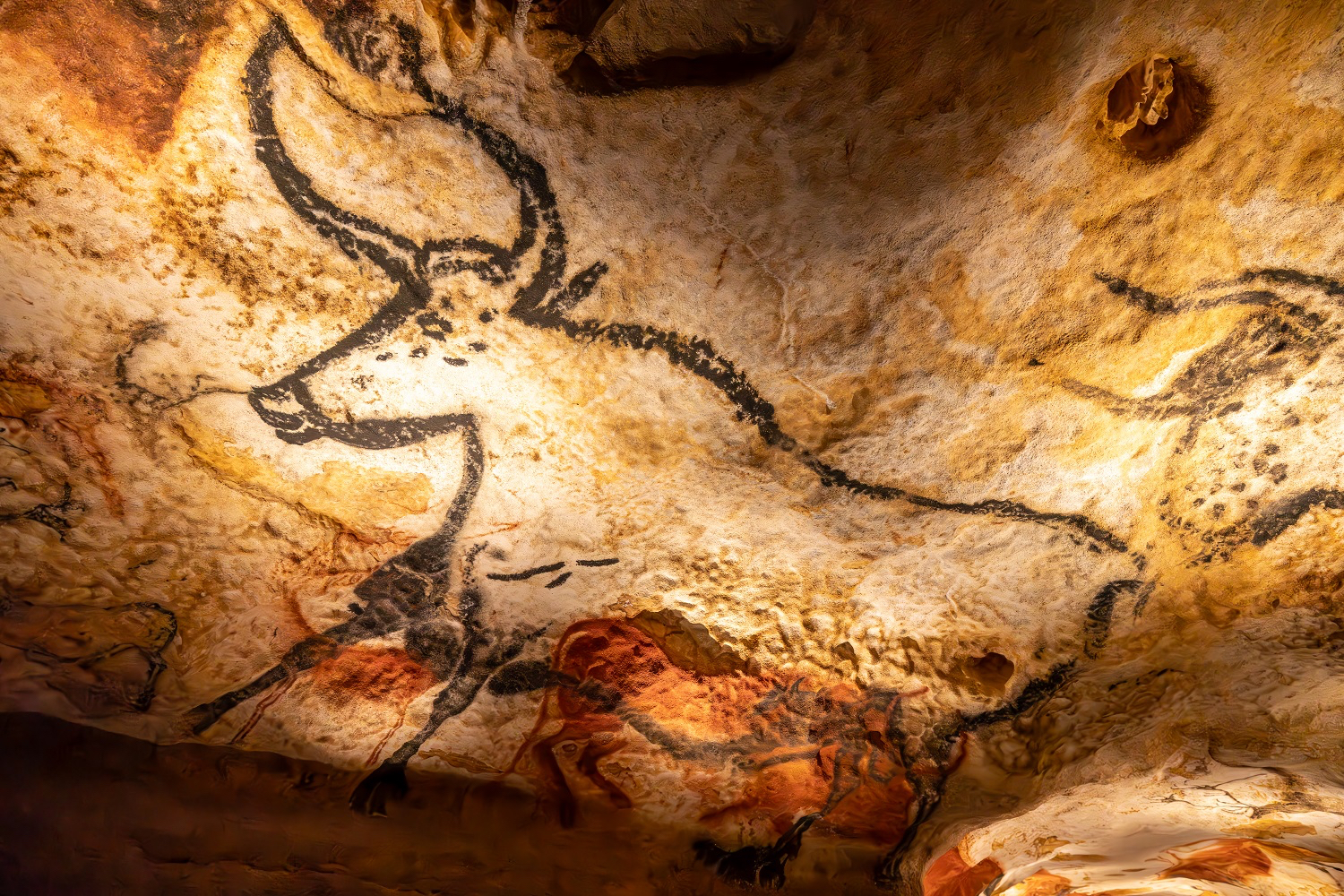
Photo Credit: Soirée Prestige Lascaux
We heard them call for a dog, Robot, who barked. Robot chased a rabbit to a small opening. Gwenn explained that one of the young men threw a rock down the opening. The rock kept falling, so they knew that this was something way more than a rabbit’s den. They agreed to come back and explore together in a week, but one of the young men didn’t wait. A few days later, he and some other friends slid down the opening. Because the caves hadn’t been accessible, along with the fact that no stalagmites had overtaken the insides, the conditions were wonderfully preserved.
Imagine how they felt, Gwenn said. What they saw. We’ll keep this our secret, they agreed. Within 72 hours, the whole town knew. The buddies who’d first found the small opening were angry that they weren’t designated as the discoverers. A feud, Gwenn explained, had lasted forty years. They’d finally reconciled in the 1980s.
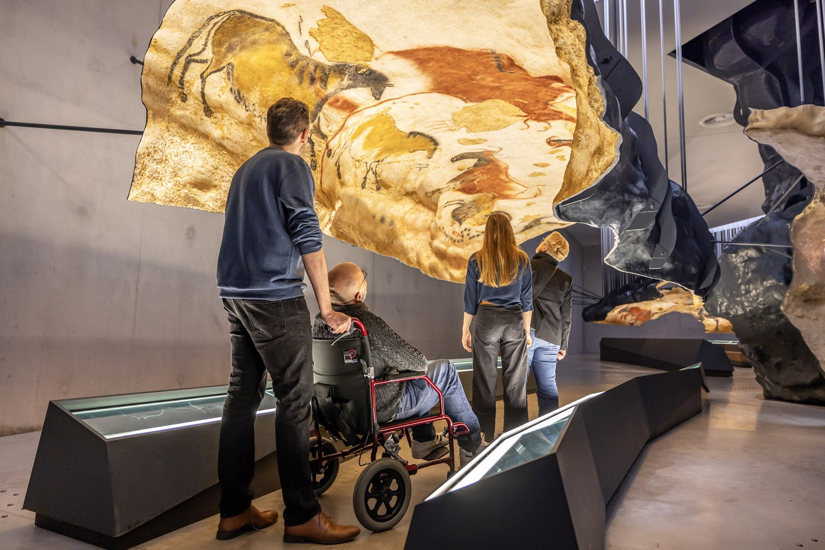
Photo Credit: Atelier 3 – Lascaux
After imagining ourselves alongside the discoverers, we descended a slope to enter the facsimile cave. Inside, the atmosphere was damp, dark, and cold. Gwenn’s tour was solemn and informative. It helped that he was clearly enthralled. With a lighted pointer, he guided our eyes alongside the walls and ceilings, pointing out the animals, symbols, and etchings. He said that he was glad that no one knew why the Cro-Magnons painted the walls or what their depictions meant.
“We need more mystery,” he insisted. “And it is very mysterious.”
He pointed out the enigmatic symbols–splat-dots (…..) and what he termed “a primitive coats of arms” (IIII) that seemed in cohort with the paintings, and in discernible patterns. “There have been all sorts of theories over the years,” he said, “all sorts of translations, but no one knows what it means.” Since there weren’t natural landscape representations, and the animals and symbols most likely acted together, Gwen landed “on the symbolic side.”
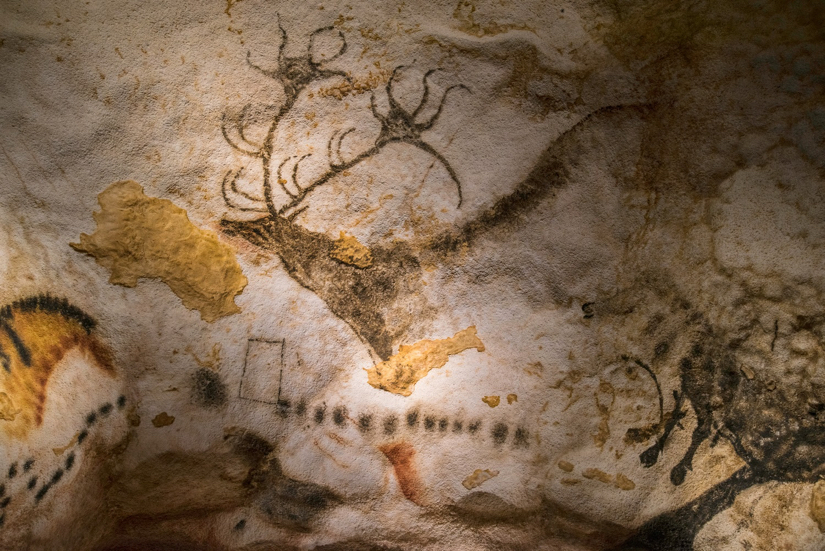
Photo Credit: Diverticule Axial 4 – Lascaux – ¸ Dan Courtice
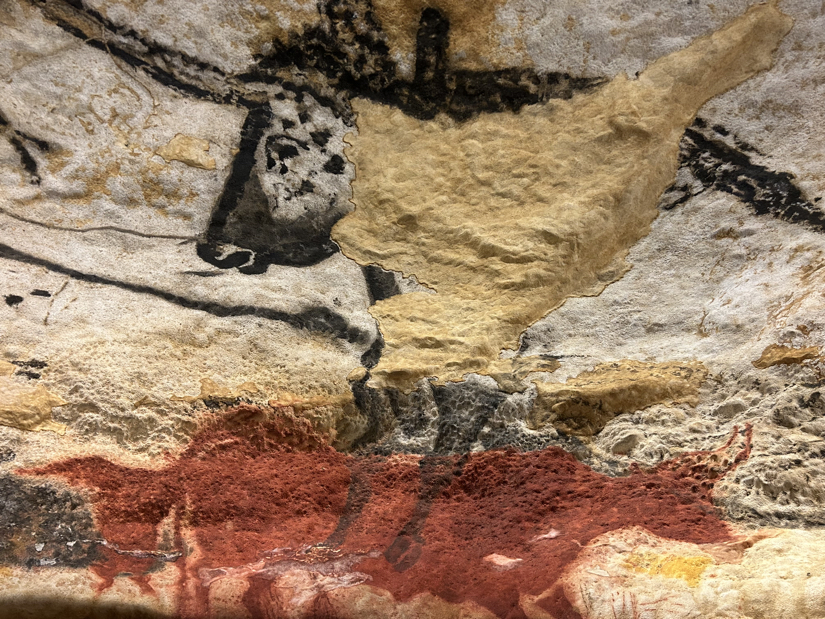
There was intentionality and purposefulness to the designs–a uniformity and patterns that could only have been achieved, Gwenn insisted, through a collective effort. He believed that ropes were most likely used for measurement. How else did they make the animals same-sized? The creators hadn’t lived inside the caves–impossible, as fires couldn’t be built. Yet they’d created a world within. Why? And how? They’d ingeniously utilized the geography of the walls for movement and perspective, like how horses appeared to gallop in a ragged section, or how the curved feature of another gave dimension to a stag’s body.
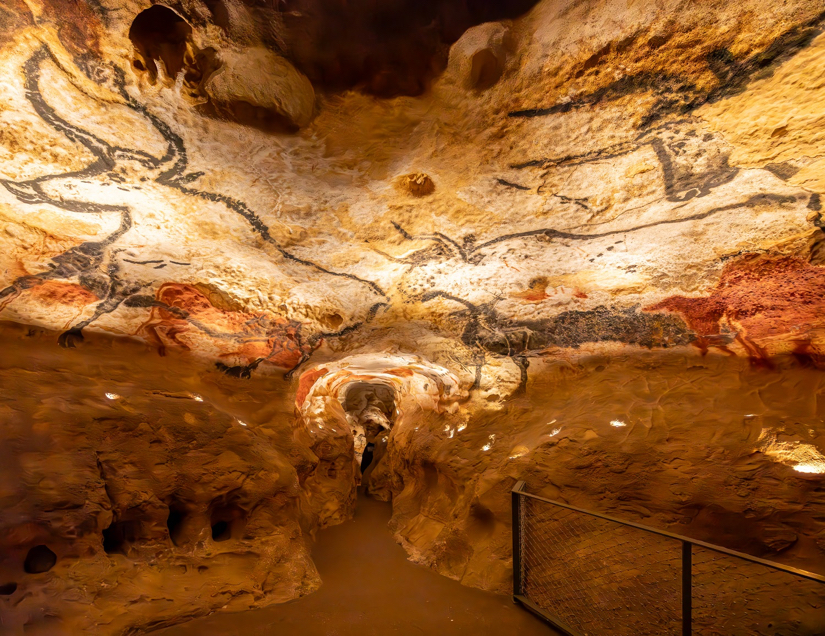
Photo Credit: Soirée Prestige Lascaux
Horses were represented the most–30 % of the images.
The animals they hunted–reindeer–weren’t represented at all. There was what appeared to be a unicorn, and a horse on the ceiling at the center. There were layered images (animals inside of animals) and animals that faced each other. A depiction of deer heads aligned and slanted upward looked to me like perhaps they were crossing a river.
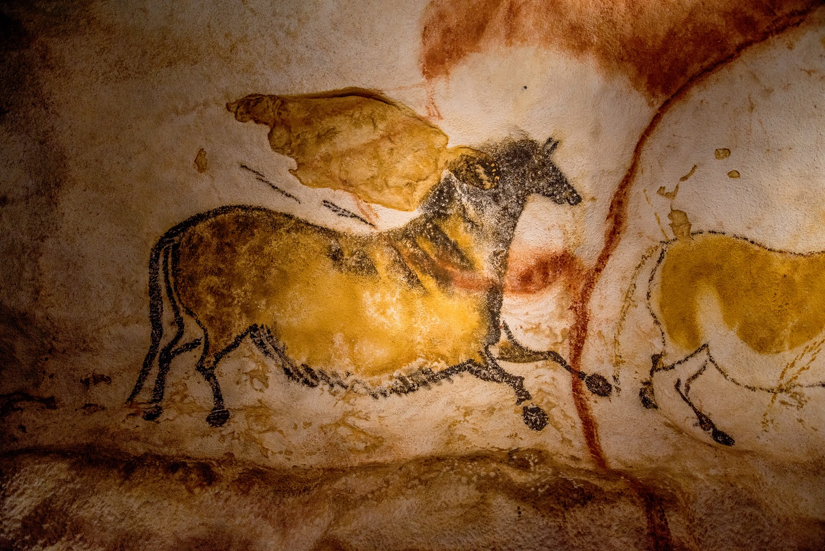
Photo Credit: Diverticule Axial 7 – Lascaux – ¸ Dan Courtice
Some of the paintings had nicknames garnered from over the year, the most well-known being Red Cow with a Black Head. There was only one image of a man. No one knows why. He’s called Bird Man, because there’s a bird near him.
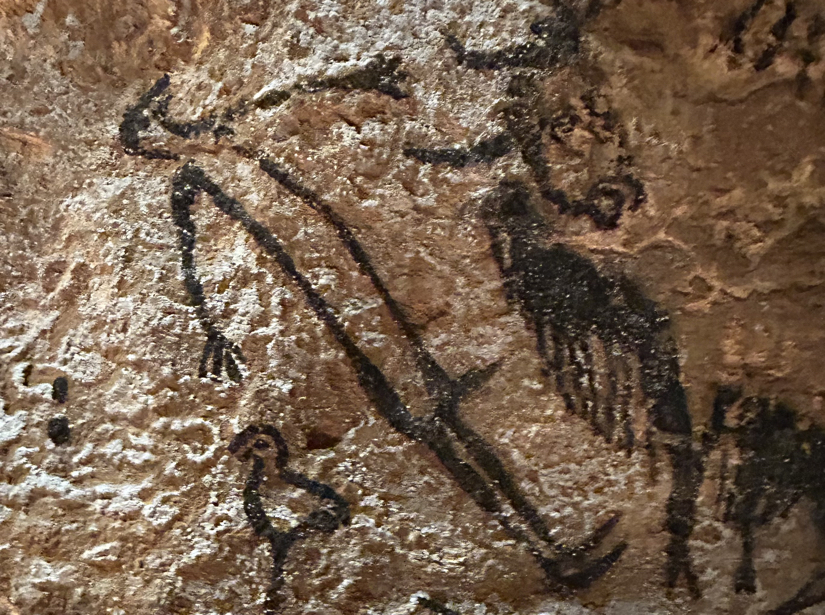
Visiting Lascaux, France’s Sistine Chapel of the Prehistoric World, Photo Credit: Victoria Patterson
After the guided tour, I wandered and listened to the self-guided audio. This section of Lascaux IV could be photographed. Visitors captured the images that they’d seen inside the reproduced cave.
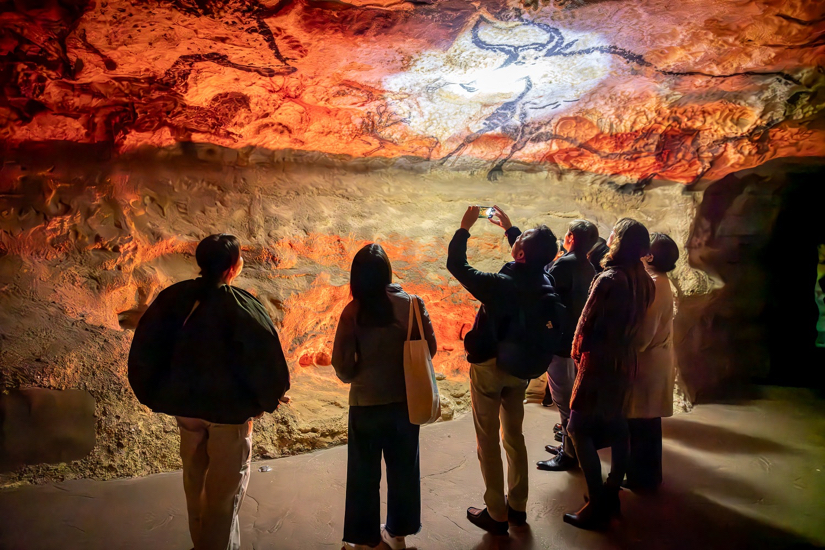
Photo Credit: Soirée Prestige Lascaux
As I sat at the café table and the kids chased each other around me, I thought
about why I’d been so moved.
The caves and their images are mysterious. I was reminded of all the varying depictions and paintings of Jesus and Mary–the religious iconography produced throughout history. 17,000 years later, what might someone make of them? But more than that, I was moved by the impulse to make art and to tell stories. I’d not really thought about how long this impulse and need to create has existed. I’d felt like I’d had a window into some of humanity’s first storytellers, and what the nomadic tribes who’d most likely pilgrimed to the sacred site had witnessed.